

Last updated: 18 September 2026 | First published: 18 September 2026
Editorial Note: This article is for informational purposes only and does not constitute legal advice. It was fact-checked against official U.S. Customs and Border Protection (CBP) and Department of State data. For specific immigration questions, consult a licensed US immigration attorney. This website may receive compensation from third-party services mentioned.
When comparing ESTA vs visa USA in 2026, UK travellers must note the key differences. An ESTA is a $40.27 online authorisation for stays up to 90 days, processed within 72 hours. A B-1/B-2 visa costs $185, requires an embassy interview, but permits stays up to 180 days.
The Electronic System for Travel Authorization operates under the Visa Waiver Program (VWP) and is ideal for short tourism or business visits. It is a completely digital record linked directly to your e-Passport. In contrast, a traditional nonimmigrant visa involves submitting Form DS-160 and securing a physical laminated foil at the US Embassy in London or the Consulate in Belfast.
Understanding the ESTA vs visa USA requirements is vital before booking flights. While ESTA offers a fast, interview-free process, it strictly prohibits overstaying. If you hold dual nationality with a restricted country, have visited places like Cuba recently, or plan to stay longer than 90 days, applying for a consular visa is the only valid route for admissibility at a US port of entry.
What Are ESTA and US Visitor Visas?
ESTA is a digital travel authorisation for VWP-eligible UK citizens, while a B-1/B-2 visa is a physical document requiring a consular interview.
As a UK traveller, you must understand the core differences in the ESTA vs visa USA comparison before planning your 2026 trip. The Electronic System for Travel Authorization (ESTA) operates as a digital record linked directly to your biometric e-Passport chip. It allows entry under the Visa Waiver Program for short tourism or business visits and costs exactly $40.27. Conversely, a B-1/B-2 nonimmigrant visa is a physical laminated foil affixed inside your passport. Securing this visa requires you to submit Form DS-160 and attend an in-person consular interview.
Travel History Disqualifications
You automatically lose ESTA eligibility and must apply for a traditional visa if you have visited Cuba on or after 12 January 2021. The same strict restriction applies if you have travelled to Iran, Iraq, Libya, Somalia, Sudan, Syria, or Yemen, or if you hold dual nationality with any of these restricted countries. Evaluating ESTA vs visa USA options early prevents travel disruptions.
Cost Comparison: ESTA vs visa USA 2026
ESTA costs $40.27 with a $10 fee retained if denied, whereas a B-1/B-2 visa costs $185 and is entirely non-refundable.
When you evaluate 2026 fees, selecting the correct entry method directly impacts your budget. As a UK traveller deciding on an ESTA vs visa USA, you must weigh the initial price against denial risks. If a consular officer refuses your visa application, you lose the entire payment.
| Feature | ESTA | B-1/B-2 Visa |
|---|---|---|
| Total Cost (USD) | $40.27 | $185 |
| Estimated Cost (GBP) | ~£32 | ~£148 |
| Refund if Denied | $10 processing fee retained | Entire fee strictly non-refundable |
Ultimately, the ESTA vs visa USA cost difference is significant, making the Visa Waiver Program highly cost-effective for eligible tourists.
Application Process Side by Side
ESTA requires a quick online form with no interview, while a US visa demands a DS-160 submission and an in-person embassy appointment.
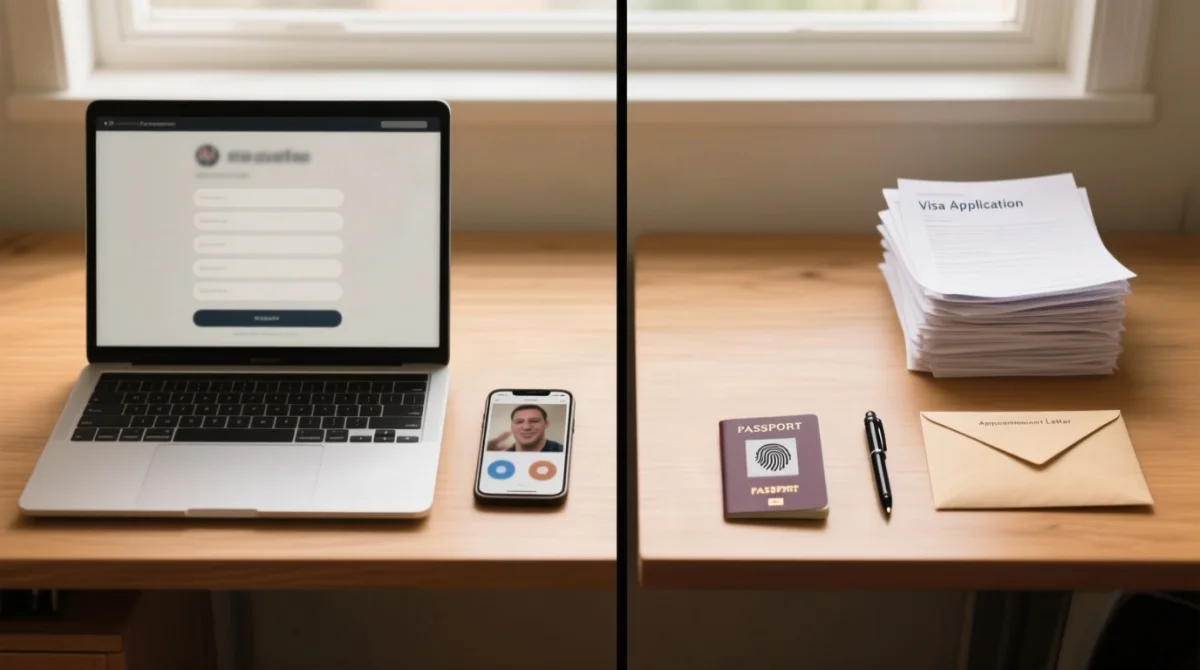
Applying for ESTA
Submit the digital form
Apply via the CBP portal at esta.cbp.dhs.gov
Provide biographic details
Upload a mandatory selfie photograph and supply social media data
Receive authorisation
Travel authorisation is granted electronically, typically within 72 hours
Applying for a US Visa
Complete Form DS-160
Submit the online nonimmigrant visa application via travel.state.gov
Schedule and attend interview
In-person appointment at the US Embassy London or US Consulate Belfast
Submit biometrics and wait
Physical biometrics are collected; consular processing takes weeks
Understanding the ESTA vs visa USA requirements determines whether you can manage the process from home. For any ESTA vs visa USA decision, remember that visa wait times in 2026 can stretch for months.
Processing Times, Validity and Maximum Stay
ESTA processes in up to 72 hours for a 90-day maximum stay, while visas take weeks but allow up to 180 days per visit.
If you apply for an ESTA, you typically receive a decision within 72 hours. This travel authorisation remains valid for 2 years and permits you to stay for up to 90 days per visit. You cannot extend an ESTA beyond this hard cap under any circumstances. Overstaying violates the Visa Waiver Program.
Conversely, a traditional B-1/B-2 visa allows you to remain for up to 180 days. While you must wait weeks or months for an embassy interview in 2026, the visa itself usually stays valid for up to 10 years. You also gain the ability to apply for an extension of stay using Form I-539.
Your choice between an ESTA vs visa USA dictates whether you face a strict departure deadline. Reviewing ESTA vs visa USA validity rules ensures you do not inadvertently violate US immigration laws.
Border Entry and Denials
Neither document guarantees entry to the United States, as a Customs and Border Protection officer makes the final decision at the border.
Arriving at the Port of Entry
Neither an ESTA nor a US visa guarantees entry; a CBP officer decides at the border. CBP officers can search devices and demand proof of return travel. For admissibility inquiries, contact the CBP Traveler Communication Center at +1-202-325-8000 or visit cbp.gov/travel.
Handling Application Refusals
If your ESTA is denied, you have no right of appeal and the system retains a $10 processing fee. To travel, you must subsequently apply for a standard nonimmigrant visa. If a consular officer refuses your B-1/B-2 visa, you forfeit the entirely non-refundable $185 fee, though you can reapply by submitting a new Form DS-160 with stronger supporting evidence.
Understanding the risks in the ESTA vs visa USA process is crucial. A denial in either ESTA vs visa USA application requires immediate reassessment of your travel plans.
Decision Guide for UK Travellers
For your 2026 ESTA vs visa USA choice, select ESTA for tourism or business under 90 days; apply for a visa for longer stays.
- Short trips: Trips strictly for tourism, transit or business lasting up to 90 days require only the web-based authorisation.
- Dual citizens: If you hold UK-US dual nationality, you cannot use either document; you must enter and exit the United States using a US passport.
- Restricted history: If you hold dual nationality with, or have visited, restricted countries such as Cuba (on or after 12 January 2021) or Iran, you must book a consular appointment.
- Minors: Children under 17 require their own valid entry document. When a child travels alone or with one parent, border officials expect a notarised parental consent letter in English.
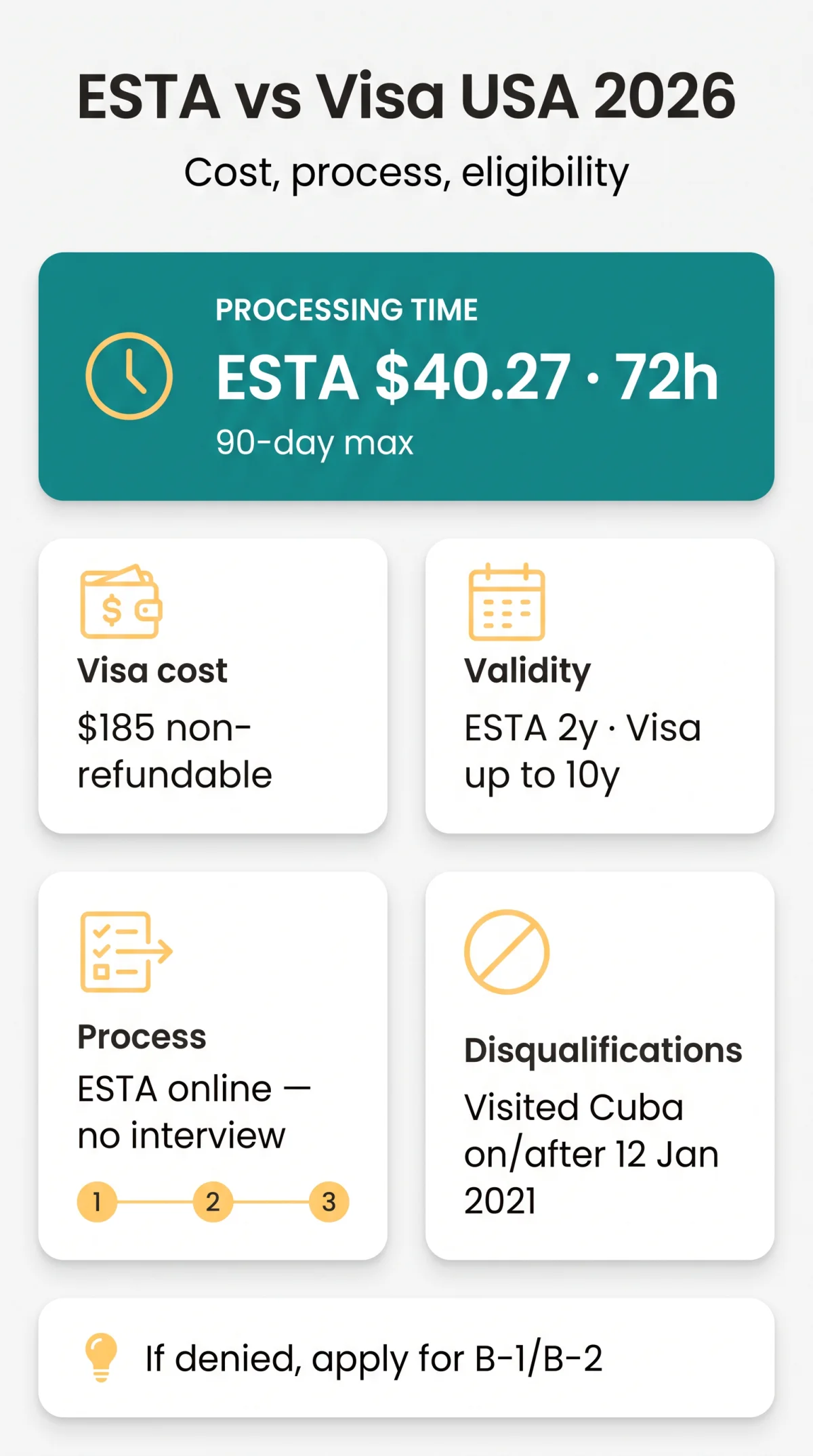
Use this checklist to simplify your ESTA vs visa USA decision.
Frequently Asked Questions (FAQ)
Is ESTA free for UK citizens in 2026?
No, an ESTA is not free for UK citizens or any other nationality. In 2026, every applicant must pay a mandatory $40.27 fee to process their travel authorisation. In any ESTA vs visa USA comparison, ESTA remains significantly cheaper.
How much is an ESTA for USA from UK?
The exact cost of an ESTA in 2026 is $40.27, which converts to approximately £32. This total fee applies to all UK travellers applying online. If your ESTA is denied, a $10 processing fee is retained.
Can I extend my stay on an ESTA?
No, you cannot extend your stay if you enter the United States on an ESTA. The Visa Waiver Program strictly limits your maximum authorised stay per visit to 90 days with zero extension options. If you need to stay longer, you must apply for a B-1/B-2 visa, which allows extensions via Form I-539.
Do I need an ESTA for transit through the USA?
Yes, UK citizens require an approved ESTA even if they are only transiting through a US airport and not leaving the terminal. Transit passengers must secure this travel authorisation up to 72 hours before departure.
What happens if my ESTA is denied?
If your ESTA is denied, there is no right of appeal. You must either reapply with a new form and a new $40.27 fee if your circumstances change, or apply for a traditional B-1/B-2 visa.
How long does a US visa interview take to schedule?
Scheduling an in-person interview at the US Embassy in London or the Consulate in Belfast can take weeks or even months. While an ESTA is processed within 72 hours, the traditional visa process is much longer.
Can I hold both a valid ESTA and a US visa?
If you already possess a valid B-1/B-2 visa, you do not need to apply for an ESTA for tourism or business purposes. A valid nonimmigrant visa already grants you permission to request entry at the border.
Does an approved ESTA guarantee entry to the US?
No, neither an approved ESTA nor a valid US visa guarantees entry into the United States. A Customs and Border Protection officer makes the final admissibility decision. In any ESTA vs visa USA scenario, border officials hold the ultimate authority.